

Mar 28, 26
Your NetSuite System Is Smarter Than You Think. You're Just Not Using It That Way
Most NetSuite systems are underutilized. Learn how AI integration unlocks real-time insights, automation, and operational efficiency without changing your core system.
Most companies that run NetSuite have spent significant time and money getting it set up correctly. The workflows are configured, the reports are built, the users are trained. And yet, month after month, the same inefficiencies persist — manual data lookups, slow approvals, support tickets that pile up, and decisions that rely on spreadsheets instead of the system everyone paid to implement.
This is not a NetSuite problem. It is an integration problem. And artificial intelligence — specifically, large language models connected directly to your NetSuite instance — is beginning to change the equation in a way that most operators have not seen yet.
The gap between what NetSuite can do and what most companies get out of it
NetSuite is one of the most capable ERP platforms on the market. It manages financials, inventory, CRM, HR, and e-commerce in a single unified system. In theory, your team should be able to get answers to almost any business question in seconds.
In practice, most of that data sits behind menus, reports, and saved searches that require training to use. The people who need information most — operations managers, finance leads, executives — are often not the ones who know how to extract it. So they ask the admin. The admin builds a report. The report gets stale. The cycle repeats.
AI changes this by giving every user in your organization a natural language interface to your data. Instead of learning where to find a report, a manager can simply ask: "What were our top five selling SKUs last quarter, and how does that compare to the same period last year?" The answer comes back in seconds, pulled directly from NetSuite.
What it means to wire AI into your ERP
The term "AI integration" gets used loosely, so it is worth being specific about what this actually looks like in a NetSuite context.
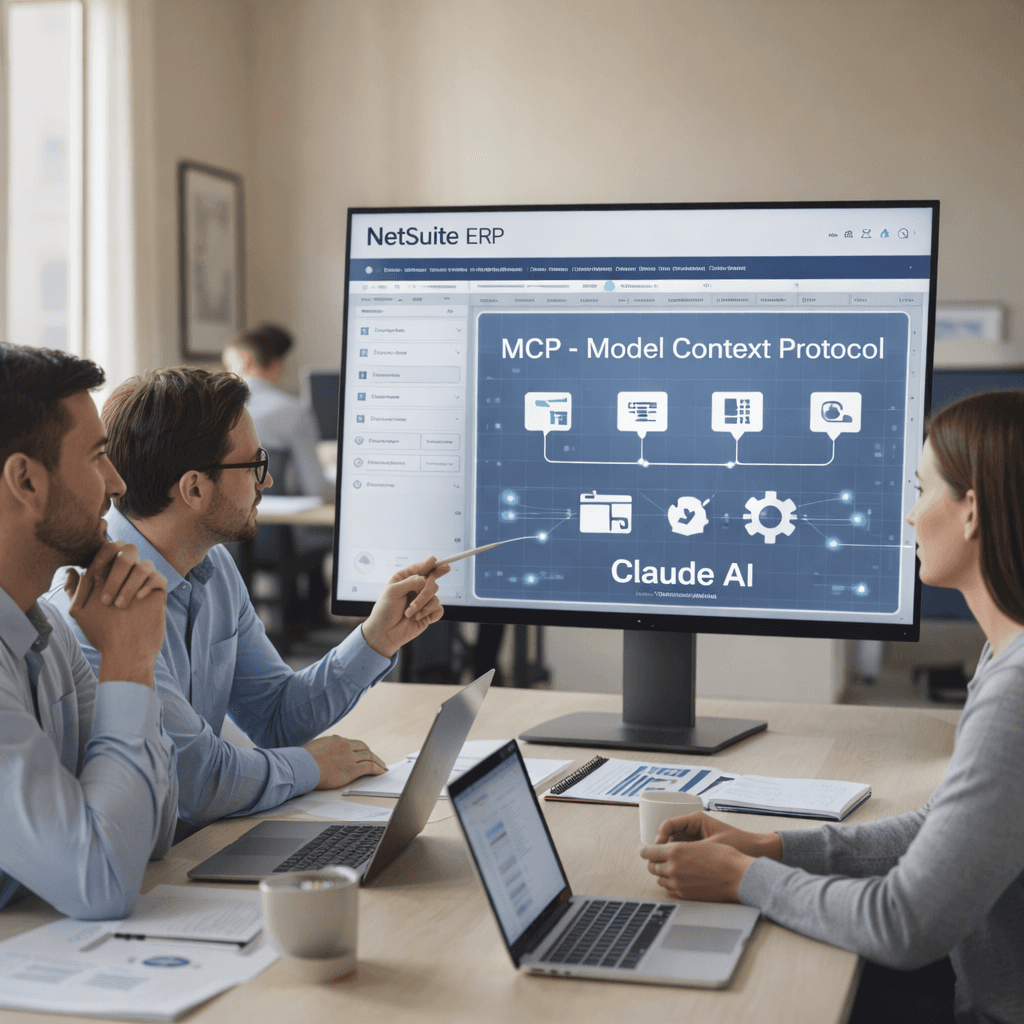
The most practical implementation right now involves connecting a large language model — such as Claude, developed by Anthropic — to your NetSuite environment through a protocol called MCP, or Model Context Protocol. This is not a chatbot bolted onto the side of your system. It is a direct, structured connection that allows the AI to read your data, understand your configuration, and take actions within NetSuite based on plain language instructions.
This means your team can:
Query financial records and operational data without writing saved searches
Automate routine workflows that previously required manual triggering
Surface anomalies and trends that would otherwise require a custom report
Get answers from the system in the same way they would ask a colleague
The difference in day-to-day experience is significant. The difference in long-term scalability is even more so.
Why this matters now, not in two years
Enterprise software moves slowly, and most NetSuite users are accustomed to waiting for features, patches, and enhancements on Oracle's schedule. AI integration is different because it does not require NetSuite to do anything new. It connects to the system you already have.
That means companies that move on this now will accumulate meaningful operational advantages while their competitors are still evaluating whether to pilot it. The organizations that are already using AI inside their ERP are not running experiments — they are shipping faster, supporting their teams more effectively, and making decisions with better data.
The window to get ahead of this is open. It will not stay open indefinitely.
The first step is understanding where you are
Before any integration can be configured, a clear picture of the current state is necessary. What modules are active? What workflows are already automated? What are the repetitive tasks consuming the most time? Where is data being pulled out of NetSuite into spreadsheets because the system cannot answer the question fast enough?
These questions form the foundation of any meaningful AI implementation. The answers determine what to build first, what to deprioritize, and what the realistic return on investment looks like. Starting without that foundation is how implementations get expensive and underwhelming.
In the next part of this series, we will go deeper into how the connection between Claude and NetSuite actually works — what it can and cannot do, how it handles your data, and what a properly configured integration looks like in a real business environment.
Recent posts





Related Articles
Your go-to source for mental health insights, tools, and advice.